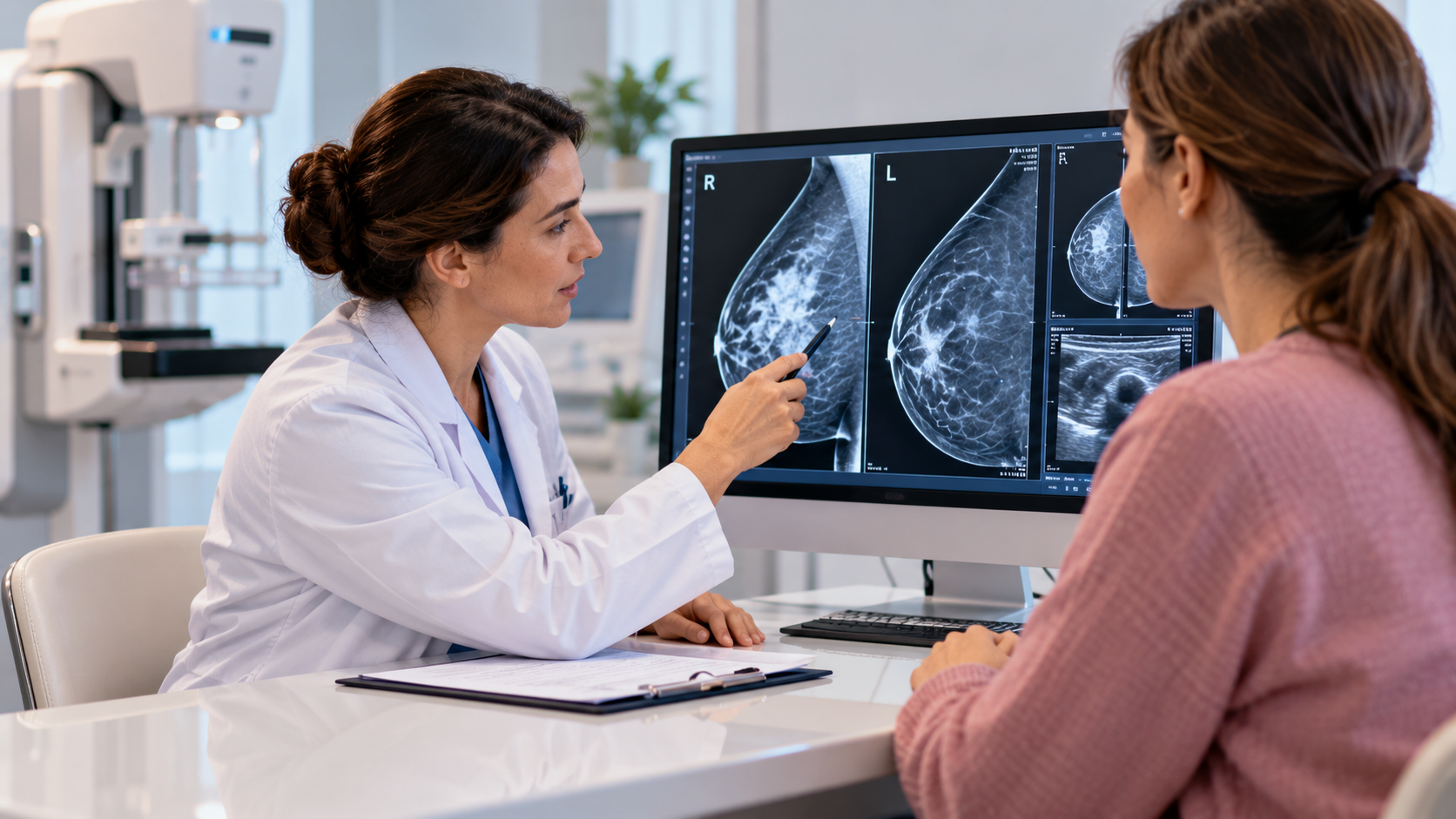
What Is Breast Cancer?
Breast cancer develops when abnormal cells in the breast begin growing uncontrollably.
Most breast cancers begin in the ducts that carry milk to the nipple or in the lobules that produce milk.
The disease can remain localized within the breast or spread into nearby lymph nodes and, in more advanced cases, to other organs.
Breast cancer mainly affects women, but men can also develop the disease.
Early diagnosis is important because treatment options and outcomes can be significantly different when cancer is found before it has spread.
What Are the Possible Symptoms?
Breast cancer does not always cause symptoms in its early stages.
Possible signs include:
- A new lump or thickening in the breast or armpit
- A change in breast size or shape
- Changes in the skin of the breast
- Dimpling or puckering
- Redness or swelling
- Changes in the nipple
- Nipple discharge that is not breast milk
- A nipple turning inward
- Persistent breast or nipple pain
Many breast lumps are not cancer.
However, any new or unexplained change should be assessed by a doctor rather than waiting to see whether it disappears.
How Is Breast Cancer Diagnosed?
If a suspicious change is found during screening or because of symptoms, doctors may use several tests.
These can include:
- Clinical breast examination
- Mammography
- Breast ultrasound
- Breast MRI in selected cases
- Biopsy
A biopsy is required to confirm whether suspicious tissue is cancerous.
During a biopsy, a small sample of tissue is removed and examined by a pathologist.
Why Is the Biopsy So Important?
A biopsy provides much more information than simply confirming the presence of cancer.
Doctors examine the tumor to determine its type and grade.
Breast cancer cells are also commonly tested for important biomarkers including:
- Estrogen receptor (ER)
- Progesterone receptor (PR)
- HER2
These results strongly influence treatment decisions.
Hormone Receptor-Positive Breast Cancer
Some breast cancers use the hormones estrogen or progesterone to help them grow.
These tumors are called hormone receptor-positive cancers.
Patients with this type of breast cancer may benefit from hormone therapy that blocks hormone activity or reduces hormone production.
Hormone therapy may continue for several years depending on the individual treatment plan.
HER2-Positive Breast Cancer
Some breast cancers produce too much of a protein called HER2.
HER2-positive cancers can grow more aggressively, but targeted medicines are available that specifically attack HER2-related pathways.
Testing the tumor for HER2 is therefore an important part of modern breast cancer diagnosis.
What Is Triple-Negative Breast Cancer?
Triple-negative breast cancer does not have estrogen receptors, progesterone receptors or excess HER2.
Because these common treatment targets are absent, hormone therapy and HER2-targeted treatments are not effective against this type.
Chemotherapy is often an important treatment, and immunotherapy may be considered in selected patients.
How Is Breast Cancer Staged?
Staging describes how far the cancer has spread.
Doctors consider factors such as:
- Size of the tumor
- Whether nearby lymph nodes contain cancer
- Whether cancer has spread to distant organs
- Tumor grade
- Biological characteristics of the cancer
Staging helps doctors create an appropriate treatment plan.
Breast Cancer Surgery
Surgery is commonly used for breast cancer that can be removed.
The two main approaches are:
Breast-Conserving Surgery
Also called lumpectomy, this removes the tumor along with a margin of surrounding tissue while preserving most of the breast.
Radiotherapy is commonly recommended afterward.
Mastectomy
A mastectomy removes the entire breast.
Some patients may have breast reconstruction at the same time as the mastectomy or at a later stage.
The choice between breast-conserving surgery and mastectomy depends on tumor size, location, breast size, genetic factors, previous treatments and patient preference.
Lymph Node Assessment
Breast cancer can spread to lymph nodes under the arm.
Doctors may perform a sentinel lymph node biopsy to check the first lymph nodes that drain the breast.
The results help determine the stage of the cancer and whether additional treatment is needed.
Radiotherapy
Radiotherapy uses high-energy radiation to destroy cancer cells in a targeted area.
It is commonly given after breast-conserving surgery and may also be recommended after mastectomy in certain patients.
The exact treatment depends on the tumor characteristics and risk of recurrence.
Chemotherapy
Chemotherapy uses medicines that travel through the bloodstream to attack cancer cells throughout the body.
It may be given:
- Before surgery to shrink the tumor
- After surgery to reduce the risk of recurrence
- As treatment for cancer that has spread
Not every breast cancer patient requires chemotherapy.
The decision depends on the cancer subtype, stage, grade and other risk factors.
Targeted Therapy and Immunotherapy
Targeted treatments act against specific characteristics of cancer cells.
HER2-targeted therapy is an important example and is used for HER2-positive breast cancers.
Other targeted medicines may be used depending on genetic or molecular findings.
Immunotherapy may also be considered for certain patients, particularly some cases of triple-negative breast cancer.
What Happens After Treatment?
Regular follow-up remains important after breast cancer treatment.
Follow-up may include:
- Clinical examinations
- Mammograms when appropriate
- Monitoring for treatment side effects
- Management of hormone therapy or other long-term medicines
- Evaluation of any new symptoms
Patients who have received surgery, chemotherapy, radiotherapy or hormone treatment may also need support for physical and emotional recovery.
Living After Breast Cancer
Breast cancer is not one single disease.
Two patients with tumors of similar size may require very different treatment because their cancers have different biological characteristics.
For this reason, modern treatment depends heavily on accurate pathology, receptor testing, staging and multidisciplinary evaluation.
Patients diagnosed with breast cancer should ideally be assessed by a team that includes breast surgeons, medical oncologists, radiation oncologists, radiologists and pathologists.
The goal is to create an individualized treatment plan that treats the cancer effectively while considering the patient's overall health and quality of life.
Reviewed by our medical coordination team
TipWay
Ready to take the next step?
Request a consultation with a specialist, check whether your insurance is accepted, or start a free medical second opinion — no commitment.