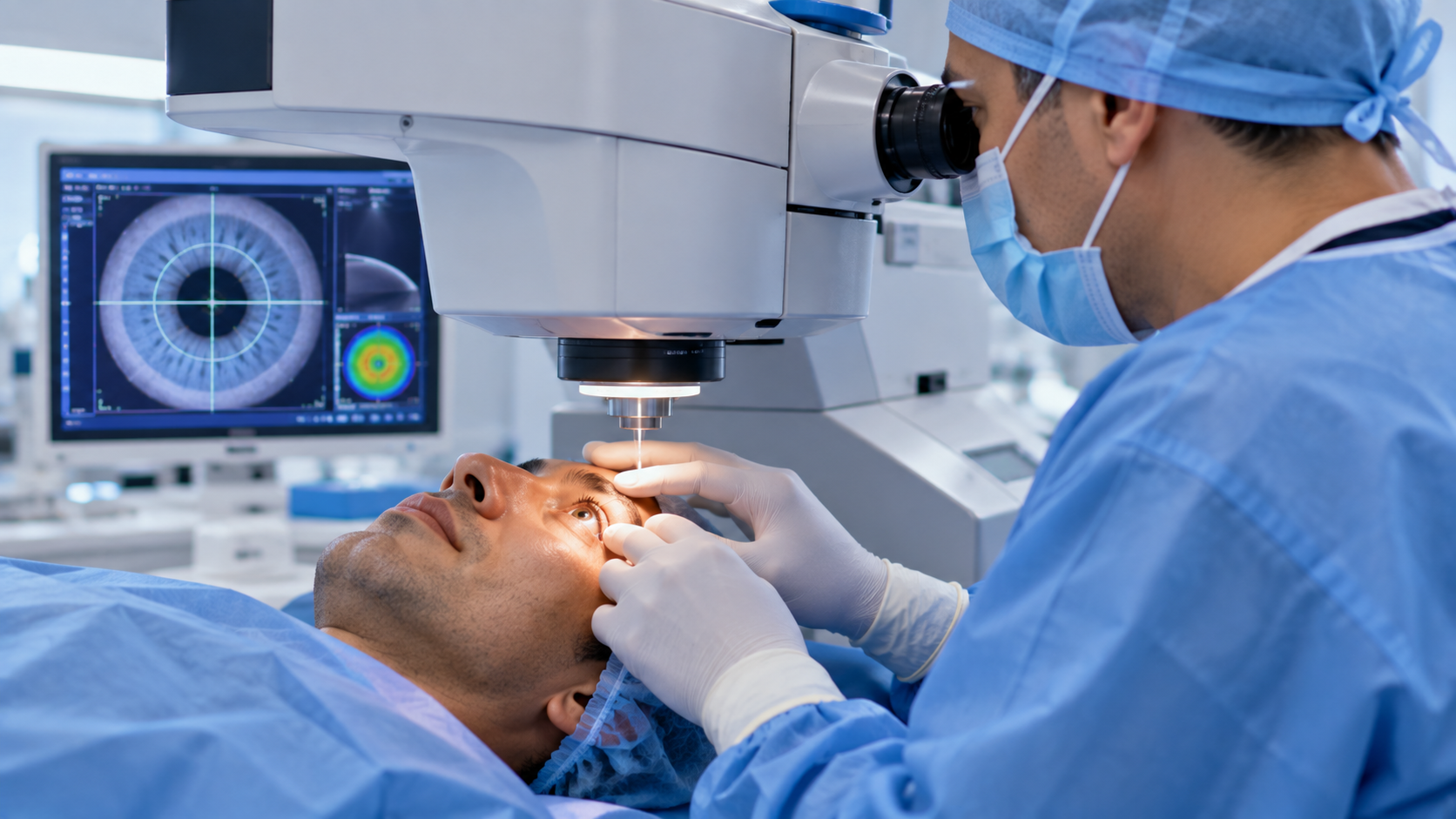
What Is Laser Eye Surgery?
Laser eye surgery, also known as laser vision correction or refractive surgery, is used to reduce dependence on glasses or contact lenses.
The treatment works by changing the shape of the cornea, the clear front surface of the eye, so that light focuses more accurately on the retina.
Laser eye surgery is commonly used to correct refractive errors such as:
Nearsightedness (myopia)
Farsightedness (hyperopia) in suitable cases
Astigmatism
Different procedures use different techniques, and the most appropriate option depends on the patient's eyes, prescription, corneal structure and lifestyle.
What Are the Main Types of Laser Eye Surgery?
Common techniques include LASIK, PRK and SMILE.
LASIK
LASIK is one of the most widely known forms of laser vision correction.
During LASIK, the surgeon creates a thin flap in the cornea. The flap is lifted, and a laser reshapes the underlying corneal tissue.
The flap is then returned to its original position.
One of the main advantages of LASIK is relatively rapid visual recovery. Many patients notice significant improvement within the first few days.
PRK
Photorefractive keratectomy, or PRK, reshapes the cornea without creating a corneal flap.
Instead, the thin surface layer of the cornea is removed before the laser reshapes the underlying tissue.
A protective contact lens is usually placed over the eye while the surface heals.
PRK generally has a slower and less comfortable early recovery than LASIK, but it may be suitable for patients whose corneas or lifestyle make flap-based surgery less appropriate.
SMILE
SMILE stands for Small Incision Lenticule Extraction.
A femtosecond laser creates a very small piece of tissue, called a lenticule, inside the cornea.
The surgeon removes this tissue through a small incision, changing the shape of the cornea and correcting the refractive error.
Unlike LASIK, SMILE does not require creation of a large corneal flap.
It is mainly used for correcting myopia and certain forms of astigmatism.
Who May Be Suitable for Laser Eye Surgery?
Not everyone who wears glasses or contact lenses is suitable for laser treatment.
Before surgery, an ophthalmologist performs a detailed eye examination.
Important factors include:
Age
Stability of the glasses or contact lens prescription
Corneal thickness and shape
Degree of refractive error
Tear production and dry-eye symptoms
General eye health
Previous eye surgery or injury
Certain medical conditions or medications
The prescription should generally be stable before surgery.
Pregnancy, breastfeeding, uncontrolled eye disease, severe dry eye or certain medical conditions may affect whether surgery should be performed or delayed.
What Happens During the Eye Examination?
A proper preoperative assessment is an important part of laser eye surgery.
Tests may include:
Measurement of the patient's prescription
Corneal thickness measurement
Mapping of the shape of the cornea
Examination of the front and back of the eye
Evaluation of pupil size
Assessment for dry eye
Measurement of eye pressure
These tests help the surgeon determine whether laser treatment is safe and which technique is most appropriate.
What Happens During Surgery?
Laser vision correction is usually performed as a day procedure.
Numbing eye drops are used, so general anesthesia is normally unnecessary.
A device gently keeps the eyelids open while the surgeon performs the procedure.
The laser treatment itself is usually very short, although the complete appointment takes longer because of preparation and postoperative checks.
Patients generally return home the same day.
Is Laser Eye Surgery Painful?
Patients usually do not feel significant pain during surgery because anesthetic eye drops are used.
Afterward, the experience depends on the procedure.
LASIK patients may experience mild burning, watering or irritation during the first several hours.
PRK typically causes more discomfort during the first few days while the corneal surface heals.
SMILE recovery is often relatively quick, although temporary irritation or blurred vision may occur.
How Long Does Recovery Take?
Recovery varies according to the procedure and the individual patient.
After LASIK, vision often improves rapidly, although it may fluctuate during the first days or weeks.
Recovery after PRK is slower because the outer corneal layer must regrow.
SMILE patients may also notice rapid improvement, with vision continuing to stabilize afterward.
During recovery, patients may be instructed to:
Use prescribed eye drops
Avoid rubbing the eyes
Avoid swimming for a period
Limit eye makeup temporarily
Avoid certain sports or dusty environments
Attend follow-up appointments
Patients should follow their surgeon's specific instructions rather than relying on a general recovery timetable.
What Are the Possible Side Effects?
Temporary side effects are relatively common after laser eye surgery.
These may include:
Dry eyes
Blurred or fluctuating vision
Glare
Halos around lights
Starbursts at night
Increased sensitivity to light
Difficulty with night driving
Many of these symptoms improve as the eyes heal.
However, some patients may experience persistent symptoms.
What Are the Possible Complications?
Although serious complications are uncommon, laser eye surgery is still surgery and involves risks.
Possible complications include:
Under-correction or over-correction
Need for additional laser treatment
Persistent dry eye
Infection or inflammation
Corneal healing problems
Reduced quality of night vision
Flap-related complications after LASIK
Corneal weakening or irregularity in susceptible patients
Rare permanent reduction in vision
A good result can never be guaranteed.
Patients should understand both the expected benefits and possible limitations before deciding to proceed.
Will I Never Need Glasses Again?
Laser eye surgery aims to reduce dependence on glasses or contact lenses, but it cannot guarantee that a patient will never need them again.
Some patients may still require glasses for specific activities.
Vision can also change naturally with age.
Presbyopia, the age-related loss of near focusing ability, usually develops from the 40s onward and can create a need for reading glasses even after successful laser surgery.
Laser surgery does not stop the normal aging process of the eye.
How Long Do the Results Last?
The corneal reshaping itself is intended to be permanent.
However, the eyes can continue to change over time because of aging, changes in prescription or other eye conditions.
Some patients may need additional correction later in life.
This does not necessarily mean the original operation has failed.
Choosing the Right Procedure
There is no single “best” laser eye surgery for every patient.
LASIK may be ideal for one person, while PRK or SMILE may be more suitable for another.
The decision should be based on a detailed examination rather than advertising, price or the popularity of a particular technique.
A refractive surgeon should explain:
Which procedures are suitable
Why a particular technique is recommended
Expected visual results
Recovery time
Potential risks
Whether glasses may still be needed afterward
The goal of laser eye surgery is not simply to achieve a specific number on an eye chart. It is to improve vision safely while preserving the long-term health of the eyes.
Reviewed by our medical coordination team
TipWay
Ready to take the next step?
Request a consultation with a specialist, check whether your insurance is accepted, or start a free medical second opinion — no commitment.